• Patient Portal
  • Pay Bill
  • Request Appointment
MCHS_Logo_2024_BLACK
    • Cardiology (Heart)
    • Gastroenterology & Hepatology (Digestive Care)
    • Neurosurgery
    • Obstetrics & Gynecology (OB-GYN)
    • Oncology (Cancer)
    • Orthopedics & Orthopedic Surgery (Bones)
    • Primary Care
    • Spine Care
    • Sports Medicine
    • Virtual Care 24/7
    View all specialties
  • Providers
  • Minnesota

    • Albert Lea
    • Austin
    • Blooming Prairie
    • Butterfield
    • Cannon Falls
    • Fairmont
    • Faribault
    • Lake City
    • Mankato
    • New Prague
    • Northfield
    • Owatonna
    • Plainview
    • Red Wing
    • Sherburn
    • St. James
    • Waseca
    • Zumbrota

    Wisconsin

    • Arcadia
    • Barron
    • Bloomer
    • Chetek
    • Chippewa Falls
    • Eau Claire
    • Ellsworth
    • Glenwood City
    • Holmen
    • La Crosse
    • Menomonie
    • Mondovi
    • Onalaska
    • Osseo
    • Prairie du Chien
    • Rice Lake
    • Sparta
    • Tomah
    mchsmap Map view
    • VirtualCare
      Virtual Care
    • SameDayCare
      Same-Day Care
    • PrimaryCare
      Primary Care
    • SpecialtyCare
      Specialty Care
    • View all care options
    • PrimaryCare
      Billing & Insurance
    • SameDayCare
      Financial Assistance
    • VirtualCare
      Price Transparency
    • Hometown Health
    • Classes & Events
    • Self-guided wellness programs
    • Mayo Clinic Connect
    • Community Resources
  • Patient Portal
  • Pay Bill
  • Request Appointment
MCHS_Logo_2024_BLACK
Search Mayo Clinic Health System
    • Cardiology (Heart)
    • Gastroenterology & Hepatology (Digestive Care)
    • Neurosurgery
    • Obstetrics & Gynecology (OB-GYN)
    • Oncology (Cancer)
    • Orthopedics & Orthopedic Surgery (Bones)
    • Primary Care
    • Spine Care
    • Sports Medicine
    • Virtual Care 24/7
    • View all specialties
  • Providers
    • Minnesota

    • Albert Lea
    • Austin
    • Blooming Prairie
    • Butterfield
    • Cannon Falls
    • Fairmont
    • Faribault
    • Lake City
    • Mankato
    • New Prague
    • Northfield
    • Owatonna
    • Plainview
    • Red Wing
    • Sherburn
    • St. James
    • Waseca
    • Zumbrota

      Wisconsin

    • Arcadia
    • Barron
    • Bloomer
    • Chetek
    • Chippewa Falls
    • Eau Claire
    • Ellsworth
    • Glenwood City
    • Holmen
    • La Crosse
    • Menomonie
    • Mondovi
    • Onalaska
    • Osseo
    • Prairie du Chien
    • Rice Lake
    • Sparta
    • Tomah
    • Map view
    • Virtual Care
    • Same-Day Care
    • Primary Care
    • Specialty Care
    • View all care options
    • Billing & Insurance
    • Financial Assistance
    • Price Transparency
    • Hometown Health
    • Classes & Events
    • Self-guided wellness programs
    • Mayo Clinic Connect
    • Community Resources
Posted By
Pao Vang, M.D.

Pao Vang, M.D.

Otolaryngology (ENT)

Recent Posts

  • Holding pizza slice outdoors
    Speaking of Health
    All about tonsil stones
    May 20, 2024
  • Child at piano keyboard
    Speaking of Health
    Does my child need ear tubes?
    April 04, 2023
Featured Topics
  • Behavioral Health
  • Cancer
  • Children's Health (Pediatrics)
  • Exercise and Fitness
  • Heart Health
  • Men's Health
  • Neurosurgery
  • Obstetrics and Gynecology
  • Orthopedic Health
  • Weight-loss (Bariatric) Surgery
  • Women's Health
Speaking of Health
Thursday, April 13, 2023

Tonsils: Tiny, but pack a big punch

Topics in this Post
  • Ear, Nose and Throat (ENT)
Child drinking orange juice

The tonsils play an essential role in keeping you healthy. These small, oval-shaped pads at the back of the throat are part of the immune system and make white blood cells. These cells attack and prevent germs that enter your body and making you sick.

While small in size, the tonsils can cause considerable pain and discomfort if inflamed. This inflammation is called tonsillitis and typically is due to a viral infection, although bacterial infections can cause tonsillitis as well.
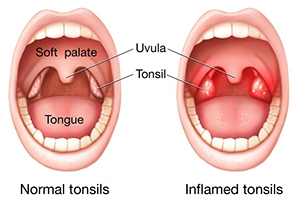
Tonsils illustration

Children are more susceptible to tonsillitis than adults for a few reasons. First, they're constantly surrounded by germs at day care or school. Kids aren't as good at hand-washing and sneezing or coughing etiquette, so there are more germs in their environments. They easily catch a cold, which can cause a runny nose and lead to tonsillitis. Their throats are smaller and many have big tonsils, which can lead to breathing problems and sleep apnea.

Sometimes, a person can have tonsillitis once or twice with no issues. But for some people, it occurs repeatedly, doesn't respond to treatments or causes complications. A common procedure called a tonsillectomy, which is the surgical removal of the tonsils, may be recommended in these cases.

Tonsillectomies are more common in children, but some adults also need them. Tonsillectomies are the second-most common procedure performed by otolaryngologists, who specialize in diagnosing and treating conditions of the ear, nose, throat, head and neck.

People who experience these symptoms may benefit from a tonsillectomy:

  • Recurrent or chronic sore throat
    A recurrent sore throat is having a sore throat several times a year, while a chronic sore throat lasts two or three months. These painful conditions don't seem to resolve on their own.
  • Frequent tonsillitis
    Usually, this is defined as at least seven episodes in the previous year, at least five episodes per year for the last two years or at least three episodes per year for the past three years.
  • Sleep apnea caused by enlarged tonsils
    When tonsils are too big, they can cause obstructive sleep apnea. The oversized tonsils block the airway, interrupting breathing and sleep.
  • Tonsils of different sizes
    Typically, tonsils are about the same size. When one is significantly bigger than the other, both tonsils should be removed to rule out throat cancer or other serious conditions.

In the past, people needed to remain in the hospital after a tonsillectomy, sometimes for days. This has changed, and most patients can return home the same day as their surgery. The procedure takes 30–45 minutes and is performed under general anesthesia in an operating room.

Most patients experience some pain after surgery, similar to a bad sore throat. This usually lasts about a week. I recommend that most people stay home from school or work during this time, drink lots of fluids and eat soft foods.

The pain usually subsides, and most people are back to normal after about two weeks. They may continue to have some pain for longer when yawning because that motion stretches the surgical site and throat. This is normal and will decrease with time.

Overall, a tonsillectomy is a safe procedure, but there is a small risk of bleeding at the incision sites. Over time, a scab forms over the incision similar to one your body forms over a cut on your arm. There's a slight risk of bleeding when the scabs fall off about seven to 10 days after surgery.

Talk with your health care team if your or your child’s tonsils appear large or different sizes, or if either of you suffer from chronic sore throats.

Pao Vang, M.D., is an otolaryngologist in Eau Claire and Rice Lake, Wisconsin.

Topics in this Post
  • Ear, Nose and Throat (ENT)

Related Posts

Smelling flowers Nasal polyps: Unassuming growths with a powerful effect
Bottle-feeding baby in arms The truth about tongue-tie
winter outdoor lady and girl 660x370 Is your sinus pressure a sinus infection?
Mayo Clinic Health System
About Us
Careers
Volunteer
Donate
Contact Us
Patient Care
Patients & Visitors
Classes & Events
Mayo Clinic Connect
Mayo Clinic
Resources
Referrals
Community Resources
Financial Assistance
Price Transparency
Compliance
Notice of Nondiscrimination
Notice of Privacy Practices
No Surprises Act
Terms of Use
Manage Cookie
Privacy Policy
© 2018 - 2026 Mayo Clinic Health System