Posted By

Recent Posts
-
Patient StoriesHeart procedure provides solution to worry
-
Transforming HealthcareTransforming heart care with advanced treatment for atrial fibrillation


Beyond open-heart surgery: A minimally invasive approach to treating a leaky valve

Mitral valve regurgitation is the most common type of valvular heart disease in the U.S. The prevalence of the condition increases with age. About 10% of adults over 75 have mitral valve regurgitation.
Mitral valve regurgitation may be called leaky valve, mitral regurgitation (MR) or mitral insufficiency.
A healthy mitral valve keeps blood moving from the upper left heart chamber to the lower left heart chamber. A leaky valve occurs when a valve between the left chambers of the heart doesn't close completely, allowing blood to leak backward across the valve. If the leakage is severe, not enough blood moves through the heart and to the rest of the body.
Slow or sudden symptoms
Mitral valve regurgitation can make you feel short of breath or tired from the lack of blood flow through the heart.
Other symptoms of a leaky valve include:
- Arrhythmia: irregular heartbeat.
- Edema: swollen ankles or feet.
- Heart murmur: sounds of blood flow across the valve.
- Heart palpitations: a sensation of a rapid, pounding or fluttering heartbeat.
The symptoms of mitral valve regurgitation may develop slowly and be mild. For some people, symptoms may not develop for many years.
In other cases, the leaky valve develops suddenly. This is called acute mitral valve regurgitation.
Severe, symptomatic mitral valve regurgitation can weaken the heart and lower life expectancy if not treated.
Diagnosing mitral valve regurgitation
Your healthcare team will confirm a diagnosis of mitral valve regurgitation after a thorough exam and testing. This is necessary as other heart conditions can cause similar symptoms to a leaky valve.
Common tests for mitral valve regurgitation include chest X-ray, cardiac MRI, echocardiogram, electrocardiogram, exercise tests or cardiac catheterization.
Through testing, your healthcare team may tell you the stage of your disease. The stage of the disease is based on symptoms, severity, structure of the valve and blood flow through the heart. The most appropriate treatment option can be determined through staging.
The four stages of heart valve disease are:
- Stage A — At risk
Heart valve disease risk factors are present. - Stage B — Progressive
Valve disease is mild to moderate, but there are no heart valve symptoms. - Stage C — Asymptomatic severe
Valve disease is severe, but there are no heart valve symptoms. - Stage D — Symptomatic severe
Valve disease is severe and causes symptoms.
Treatment for leaky valve
The goal of treatment is to improve heart function and reduce symptoms. This may include regular monitoring, medication, valve repair or valve replacement.
For severe cases, the healthcare team may recommend repairing a leaky valve with open heart mitral valve repair or replacement surgery. In suitable patients, the mitral valve also can be repaired without open heart surgery using a catheter-based endovascular procedure.
Your healthcare team will discuss your symptoms and stage of disease with you when evaluating treatment options.
Transcatheter edge-to-edge repair
Transcatheter edge-to-edge repair, or TEER, of the mitral valve is an alternative to traditional open-heart surgery to treat a leaky valve. The minimally invasive procedure is performed in a cardiac catheterization lab.
During the TEER procedure, the leaky valve is accessed with a catheter, or thin tube, passed through the right femoral vein in the leg to the heart. A small, implanted clip is attached to the valve to help it close more completely, restoring regular blood flow through the heart. The recovery is quicker because a large chest incision is not needed.
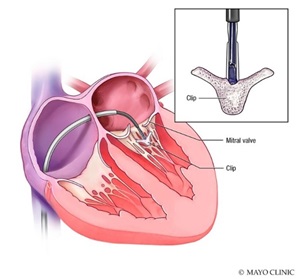
A TEER procedure may be a good option if you have severe mitral valve regurgitation, aren't a good candidate for open-heart surgery, or have heart failure with mitral valve regurgitation due to heart enlargement.
Talk with your healthcare team if you have symptoms of mitral valve regurgitation. A cardiologist can determine if you are a candidate for TEER. Your healthcare team will review the risk of complications, how effective the procedure may be and the possible benefits.
Next steps:
- Learn about cardiology services.
- Find a cardiologist near you.
- Read about advanced treatment for atrial fibrillation.
- Read more articles about heart health.
Gurpreet Singh, M.D., is a cardiologist in Eau Claire, Wisconsin.