Recent Posts
-
Speaking of HealthAfib and irregular heartbeat symptoms: What you need to know
-
Speaking of HealthPink eye: Symptoms, causes and when to seek care
-
Speaking of HealthWhen to seek care for cold, flu and RSV



Men's health: How is benign prostatic hyperplasia treated?
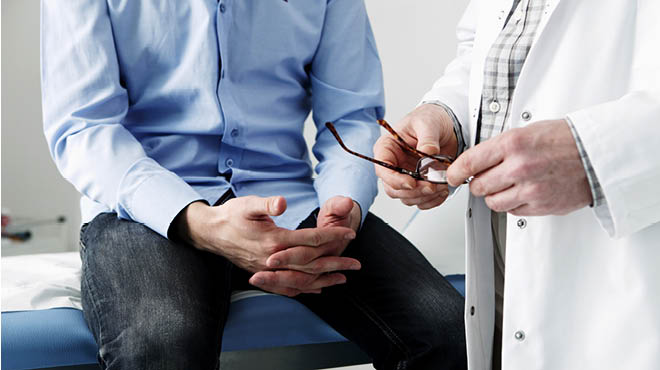
If you've been diagnosed with benign prostatic hyperplasia (BPH) — noncancerous tissue growth within the prostate — it's time for you and your healthcare team to talk about treatment options. These options depend on the severity of your symptoms, which can range from having a weak urine stream to not being able to urinate at all. Most treatments are done in the outpatient setting, including your provider's office, while others may require a hospital stay.
Behavior modifications
If you're experiencing bothersome, but not severe, symptoms, such as having a weak urine stream or frequently getting up at night to urinate, your provider may have you start with behavior modification, including:
- Changes to your diet
Some foods, such as chocolate, citrus, carbonated beverages and caffeine, can irritate your bladder, which can increase your urge to urinate. Cutting back on these foods may ease your symptoms. - Fluid intake
Reducing the amount of fluid you drink before bedtime can decrease your need to urinate during the night. - Timed urination (voiding)
Holding your urine also can irritate your bladder, so making a point to urinate every hour-and-a-half to two hours can reduce the urge to go "now."
Medications
If these behavior modifications no longer work as effectively for you, your healthcare provider may prescribe a medication, which you'll need to take every day.
There are a number to choose from to give you the best outcomes, including:
- Alpha blockers
These drugs relax muscles in the bladder and prostate and open up the urinary channel to reduce blockage. There are multiple types of alpha blockers, but Flomax (tamsulosin) specifically targets the prostate. Side effects include decrease in blood pressure, dizziness and lightheadedness. They also can cause semen to go back into the bladder instead of the penis (retrograde ejaculation). This may be startling, but it's harmless. - 5-alpha reductase inhibitors
These medications work to shrink the prostate by lowering the production of a specific hormone. They're only prescribed for men with higher prostate-specific antigen (PSA) levels and larger prostates. There are more side effects, and it may take six to nine months to see any results. Men may have a lower sex drive, and some will experience erectile dysfunction.
Surgical procedures
You and your healthcare team may decide that in-office therapies or surgery would be the best treatment option for you. They are done to shrink or remove overgrown prostate tissue. This can relieve bladder obstruction caused by an enlarged prostate.
Minimally invasive procedures, also known as therapies, are best for people with smaller prostates who can't tolerate anesthesia or are concerned with preserving ejaculation and erections. The least invasive options can be done in your provider's office or in an operating room. These are known as transurethral procedures and don't require an incision.
Some treatments work better than others, depending on your symptoms, treatment goals and the size of your prostate. Most of these treatments preserve sexual function and have little or no impact on erectile or ejaculatory function.
Talk with your healthcare team about which of the following options might be best for you:
- Temporarily implanted nitinol device
This procedure reshapes the tissue of the prostatic urethra and the bladder neck to create a wider channel through which urine can flow. A nickel titanium device is inserted into the prostatic urethra in a narrow, folded configuration. As the device expands, it exerts gentle pressure to reshape the prostatic urethra and opening of the bladder. After five to seven days, the device is removed. - Prostatic urethral lift PUL
This procedure reshapes the prostate using a small, permanent implants to compress and lift the side of the enlarged prostate. This increases the opening of the urethra. - Steam therapy
This therapy, also known as uses steam to reduce the size of the prostate. During the treatment, a tiny needle is inserted into the urethra and positioned within the prostate gland. In nine seconds, the needle produces a 2-centimeter-wide steam ball that shrinks surrounding prostate tissue. - Transurethral resection of the prostate TURP and photo selective vaporization PVP
During a TURP, a lighted scope is inserted into the urethra and the surgeon uses an electric loop to remove all but outer part of the prostate. TURP generally relieves symptoms quickly, and most men have a stronger urine flow soon after the procedure. PVP is laser therapy, also called transurethral electroevaporation of the prostate, and performed in an operating room under anesthesia. A surgeon inserts a thin, tube-like instrument into the urethra. This instrument has a lens, light and tool that sends out an electrical current to destroy prostate tissue. Heat from the electrical current seals small blood vessels, reducing the risk of bleeding. This procedure destroys or removes overgrown prostate tissue and is a good choice if you need to stay on blood thinners. - Prostate enucleation BipoLEP or HoLEP
This procedure removes nearly the entirety of the prostate gland without an incision. It is often a good option for patients with especially large prostates, the inability to stop blood thinners or in significant urinary retention. A thin instrument is inserted into the urethra. Then a laser cuts the prostate tissue into small removable pieces. Enucleation of the prostate can be performed with either bipolar plasma energy or light energy. These are known as BipoLEP and HoLEP. - Prostatectomy
This minimally invasive surgery removes tissue blocking the flow or urine. It usually requires a one-night stay in the hospital and is done laparoscopically through a small incision in your side, most often using a surgical robot.
Wherever you are on the range of symptoms, there are treatment options that can relieve them. Be sure to discuss treatments thoroughly with your provider, asking any questions that will help you make the best choice.
Find a urology specialist near you.
By Mayo Clinic Health System staff